Investments are not just a way of portfolio diversification for NRIs, but they’re also about accumulating wealth and meeting future goals. However, knowing about tax saving investments is a must in this case. There are several tax saving investments that you can choose from in order to make your portfolio more efficient. A higher tax outgo only results in lower net returns for your investments. This explains the importance of tax efficiency and tax-saving instruments for your portfolio.
Understanding Tax Saving Investments for NRIs
So, what are tax saving investments? Whenever you’re doing goal-based investment planning and deploying your money in various investments, tax-saving ones are those that minimise your tax liabilities or give you tax deductions/exemptions. In this case, it is worth knowing that you can save taxes in India by leveraging options such as ULIPs and ELSS to name a few. This will get you a maximum deduction of INR 1.5 lakh as the Section 80C deduction.
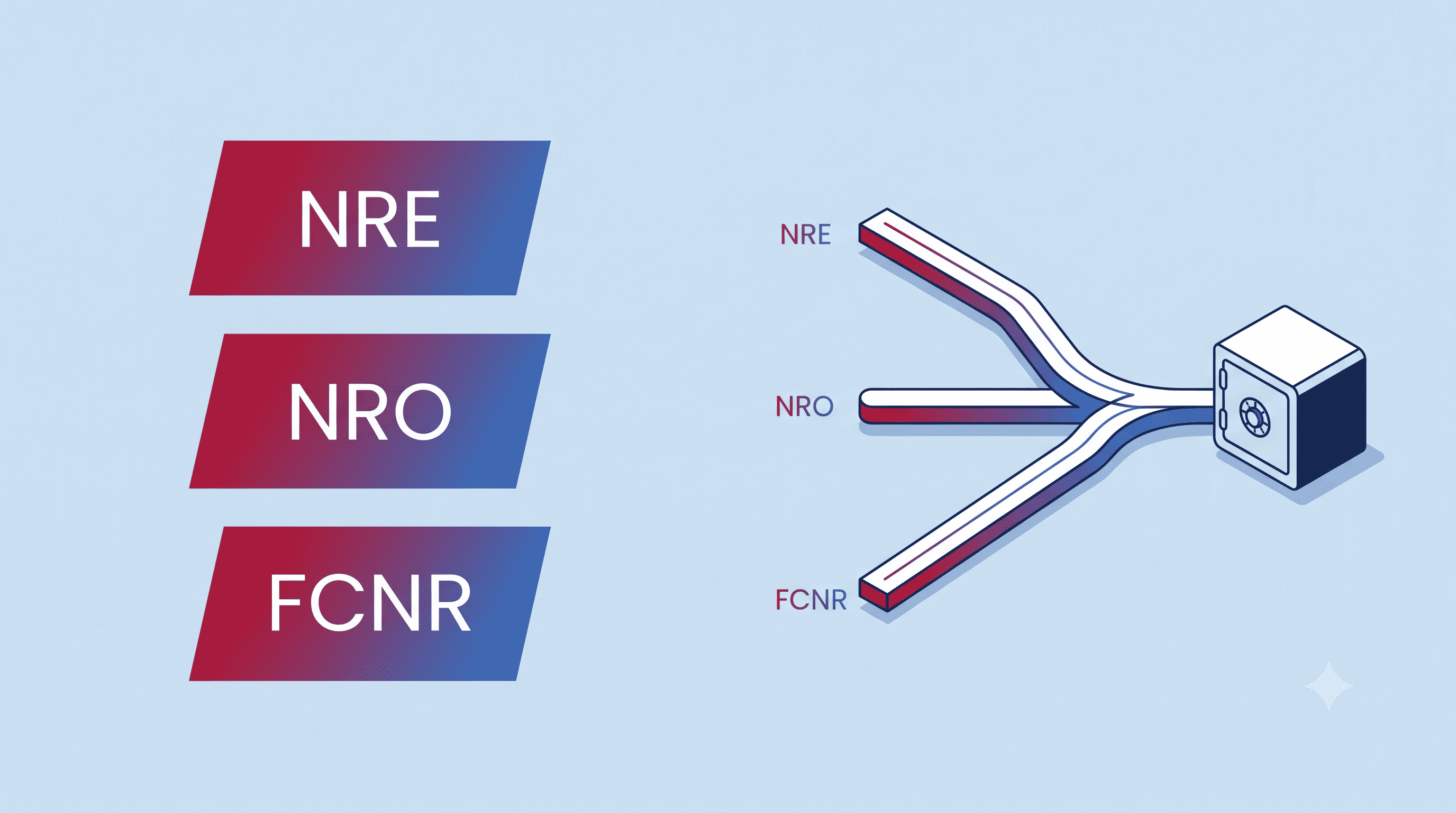
At the same time, interest from NRE/FCNR is generally exempt in India, while the NRO interest is taxable. Keep this NRI taxation principle in mind while investing. Also, remember that you cannot open any new PPF or National Savings Certificate (NSC) as an NRI, but you may continue your existing ones (opened before changing your residency) until maturity on a non-repatriation basis. You may also utilise DTAAs (double taxation avoidance agreements) to avoid paying taxes on the same income in both India and your country of residence.
Basics of Income Tax Investments in India
Knowing the old tax regime vs new tax regime aspects is crucial in this case, since the latter comes with only a standard deduction and certain other benefits, while the former contains 80C and other deductions. However, it is important to note that the standard deduction of ₹75,000 under the new tax regime is applicable only for salary income that one earns in India, and not interest or rental income. Increased income tax payments may raise the financial burden for you as a taxpayer. The income tax slabs are also based on varying taxpayer categories and your annual income.
There are tax deductions and exemptions introduced by the Government on certain investments to help you lower your income tax liabilities. If you qualify for these tax benefits, it will help you lower your taxable income and subsequent liabilities. Analyse both the regimes and the tax-saving options that are available before you start investing or diversifying your portfolio.
Top Tax Saving Investment Options in India
Some of the well-known tax-saving schemes in India include the following:
-
USD-denominated Investment Linked Insurance Plans (ILIPs), which help you earn returns in a stable global currency and hedge against inflation. Policies issued through IFSC based insurance office (IIO), GIFT City help you get tax-free maturity without the domestic ₹2.5 lakh annual premium cap. Get personalised goal-based investment planning guidance while benefiting from tax-efficient, dollar-denominated returns and full capital repatriation. Payouts from GIFT City are fully repatriable in USD, a major advantage over NRO funds, which require Form 15CB and are capped at $1 million per year. Certain ULIPs bought through GIFT City offer tax-free maturity benefits regardless of the domestic premium cap, provided the 1:10 sum assured ratio is maintained. You can explore HDFC Life International’s ILIPs.
-
ELSS- Equity linked savings schemes offer deductions under Section 80C up to INR 1.5 lakh per year. These funds invest at least 65% of their money in equity, with the remainder in fixed-income securities.
-
PPF- If you already have a PPF account (NRIs cannot open new accounts), then you will get similar Section 80C deductions up to INR 1.5 lakh per year on your contributions for a total lock-in period of 15 years. Also, the maturity amount is exempt from taxes, along with the interest.
-
National Pension System (NPS)- NPS is one of the most popular income tax saving instruments, where you have to make a certain contribution and claim deductions up to INR 150,000 under Section 80CCD (1) on your own contributions, subject to the applicable percentage of salary/income limits and the overall ₹1.5 lakh limit shared with Sections 80C and 80CCC. There is an additional deduction of up to INR 50,000 under Section 80CCD (1B) for voluntary contributions. NRIs are only eligible for Tier-1 accounts. Tier-2 accounts are restricted for them.
-
Tax-Saver FDs- Earnings are taxable from FDs, although there are tax-saver FDs with five-year lock-in periods, which offer deductions up to INR 1.5 lakh under Section 80C.
-
Unit Linked Insurance Plans (ULIPs)- This is one of the best tax-saving investment options, giving you both life insurance coverage and market-linked returns. Eligible ULIP proceeds may also qualify for exemption under Section 10(10D), subject to the applicable conditions, including the premium and sum-assured requirements.
-
Senior Citizen Savings Scheme- SCSS applies only to senior citizens and comes with the same deductions up to INR 1.5 lakh under Section 80C. However, the interest earnings are taxable.
-
Life Insurance- There are attractive life insurance tax benefits available for investors as well. You can get term insurance tax benefits up to INR 1.5 lakh per year under Section 80C, although your premium should not be more than 10% of the sum assured.
These are some of the best tax-saving options you can consider for your portfolio, although do note that the Section 87A tax rebate is not available for NRIs (only for resident Indians).
How to Plan and Execute Tax Saving Investments
Here are some strategies worth following in this regard:
- Consult a financial advisor to map your total tax outgo and investment options.
- Try to maximise the Section 80C deduction benefits by investing in multiple instruments like unit-linked insurance plan options and life insurance.
Risk, Returns, and Smarter Tax Strategies
How to invest to save tax? You should check the risks and return potential of your investments. Some risks include currency risks—mitigated with FCNR (B) deposits—and market volatility. Diversify across ULIPs, ELSS, and high/low-risk funds to balance your portfolio.
You can also consider investing in AIFs in GIFT City, Gujarat, which offer lower transaction costs and tax exemptions. Maximise your Section 80C and 80D deductions; in the context of Section 80D, you can get an additional deduction of INR 50,000 by paying health insurance premiums for senior citizen parents in India.