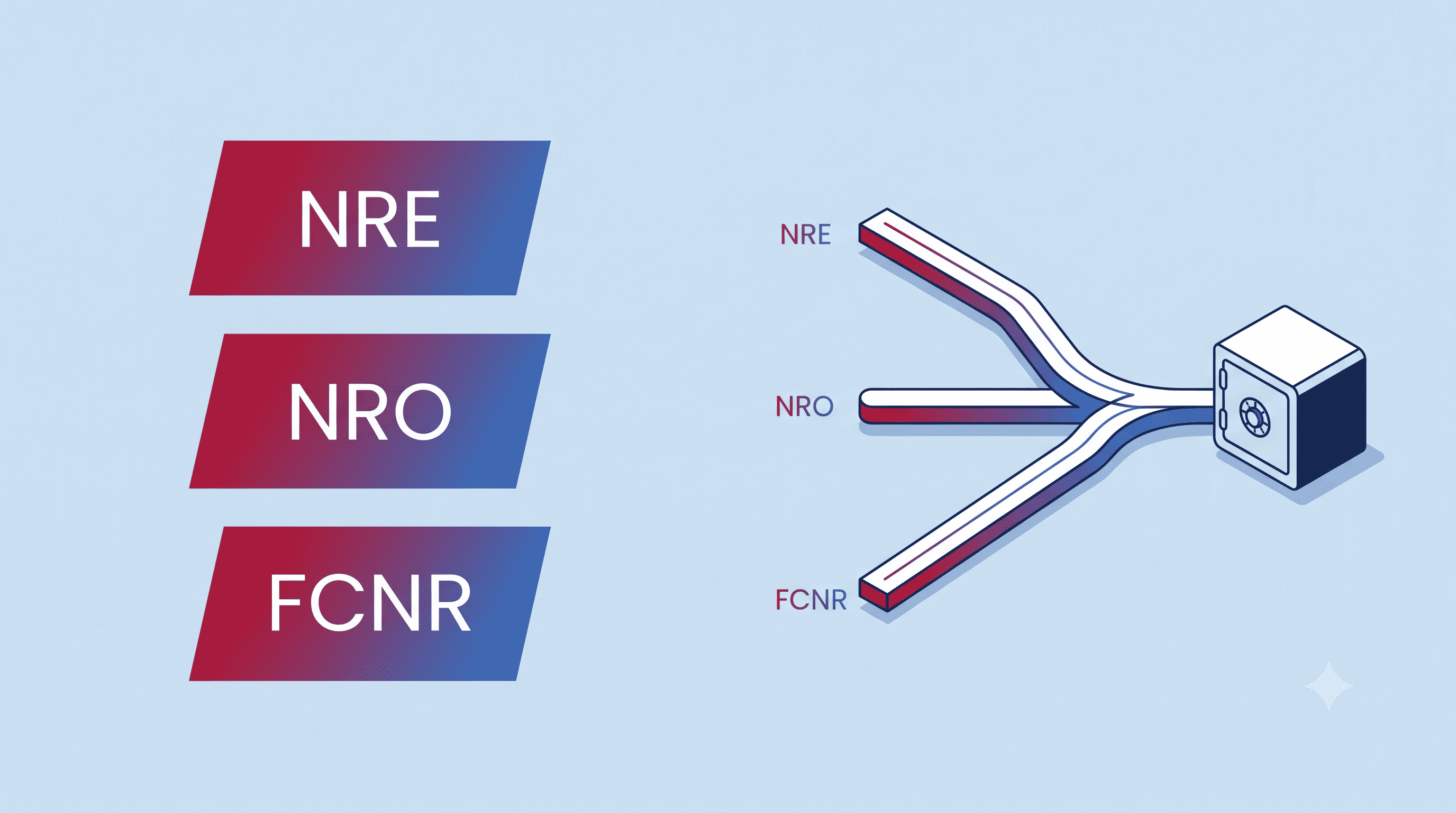
Which is the best account for your needs as an NRI? This is where knowing about NRE, NRO, and FCNR accounts is important. Each of these accounts comes with its own set of specific benefits that you should be aware of. Let’s look at these aspects in slightly more detail below.
What Are NRE, NRO, and FCNR Accounts?
What is NRE account for NRIs? These are accounts for depositing and managing foreign earnings in India, holding funds in INR (Indian rupees). The interest that you earn is tax-exempt in India, which is one of the main NRE account tax benefits for NRIs. The funds and accumulated interest may also be repatriated out of India. NRO (Non-Resident Ordinary) accounts are for managing the income that NRIs earn in India, including dividends, salaries, rental income, etc.
These accounts hold funds in INR, with deposits in foreign currencies converted to the same. The income is subject to taxes in India, while the interest is taxable as well. Repatriation is possible up to US$1 million annually for capital assets, while current income is fully repatriable. FCNR (Foreign Currency Non-Resident) accounts are fixed-term deposit accounts that can hold funds in foreign currencies like USD, GBP, EUR, etc. The interest is tax-exempt in India, with the principal and interest being repatriable as well. These are only available as fixed deposit accounts with tenures between 1 and 5 years.
Difference Between NRE, NRO, and FCNR Accounts
What is the difference between NRE, NRO and FCNR accounts? Here’s looking at the same below.
| Key Aspect | NRE Account | NRO Account | FCNR Account |
|---|---|---|---|
| Objective | Park any foreign income in India | Manage the income that is earned in India | Fixed deposit account for foreign income |
| Currency | INR | INR | Foreign Currencies (USD, GBP, EUR) |
| Repatriation | Completely repatriable | Up to $1 million per financial year | Fully repatriable (principal and interest) |
| Interest Taxation | Tax-free | Taxable in India | Tax-free in India |
| Type of Account | Savings, Fixed Deposit, Current | Savings, Fixed Deposit, Current | Only Fixed Deposit |
| Joint Holder | With another NRI or Resident Indian (Close relative on ‘Former or Survivor’ basis) | With a resident Indian or NRI | With another NRI or Resident Indian (Close relative on ‘Former or Survivor’ basis) |
| Suitable For | Remittance, salary abroad, and investments | Pension, rent, and dividends in India | Stable deposit returns and hedging against currency risks |
Benefits of NRE, NRO, and FCNR Accounts for NRIs
There are several NRE vs NRO account benefits, along with specific advantages of FCNR accounts. In case you have income in India, arising from dividends, rent, local salary income, or pensions, then you can open an NRO account. It will help you manage money better in the country. In case you are looking to buy stocks, invest in mutual funds, or keep your savings in India on a non-repatriable basis, you can choose an NRO account. You may also convert your current residential bank account into an NRO account to begin with.
Can I Convert NRO to NRE Account? Understanding the Process
You cannot directly change the account classification, although you may transfer funds to NRE accounts from NRO accounts. It is allowed by the RBI (Reserve Bank of India) till a threshold of $1 million for each financial year. The process needs some documentation, including the FEMA declaration, signed transfer request, proof of source of funds, and possibly the Form 15CB and Form 15CA.
The process involves paying taxes on NRO funds, ensuring that TDS on the earnings in the account have been paid prior to the transfer. Gather the required documents, including the signed letter/cheque for fund transfer, signed FEMA declaration, and evidence of the source of funds. Get the tax forms if required and submit the application to the bank.
How HDFC Life International Helps NRIs with Seamless Financial Management
If you are looking for NRI investment plans, you can also explore Global Wealth Advantage Plans, (US Dollar denominated Investment Linked Insurance Plan) offered by HDFC Life International. Premium can be paid through NRE/FCNR accounts as per IFSCA regulations.
You can expect smooth management of your returns digitally and seamless premium payments likewise. Get tailored advice for setting up your accounts as an NRI, added benefits of GIFT City regulations and compliance, and of course, a tax-efficient portfolio that will help you preserve global capital, gain extensive worldwide coverage, and earn stable returns in global currencies.